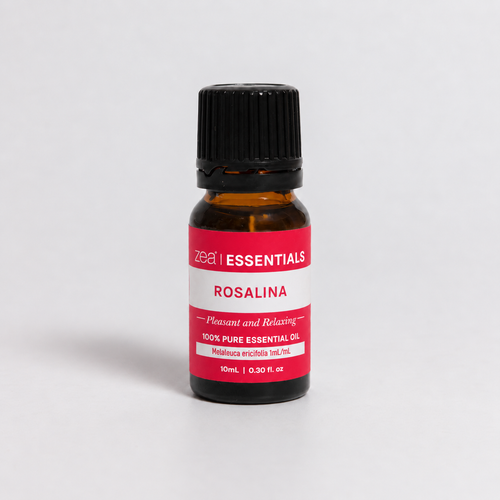
Rosalina essential oil comes from Melaleuca ericifolia, a paperbark tree native to south-eastern Australia, and it is usually described as "Tea Tree, but softer" without anyone explaining why. The reason is chemistry, not marketing. Rosalina oil is dominated by linalool, commonly 35 to 55% of the oil, alongside 18 to 26% 1,8-cineole1. Tea Tree oil (Melaleuca alternifolia) is built around an entirely different constituent, terpinen-4-ol, which has to sit at 30 to 48% under the international commercial standard1. Same plant family, same tea-tree-like reputation, genuinely different oil.
This article covers what Rosalina actually is, how its chemistry compares to Tea Tree and to its close cousin Nerolina, why it reads as gentler on the nose, and how to use it in practice.
What is Rosalina essential oil?
Rosalina is the common trade name for the essential oil steam distilled from the leaves and twigs of Melaleuca ericifolia, commonly known as Swamp Paperbark. The species is described in botanical records as a shrub or small tree to 8 metres high with corky bark, scattered or whorled linear leaves around 7 to 15mm long, and dense white flower spikes2. It occurs naturally along the New South Wales coast south from the Hastings River, through Victoria and into Tasmania, favouring heath, dry sclerophyll forest, stream banks and low-lying coastal swamps2. That swamp and stream-bank habitat is where the "Swamp Paperbark" name comes from, and it is the same broad Tasmanian and Victorian range Zea already sources Kunzea oil from.
Botanically, Rosalina sits in the genus Melaleuca alongside Tea Tree (Melaleuca alternifolia) and Nerolina (Melaleuca quinquenervia). All three share the Myrtaceae family's tea-tree-like aroma family, fine narrow leaves and white bottlebrush-style flowers, which is exactly why people assume the oils behave the same way. The constituent chemistry says otherwise.
Rosalina vs Tea Tree vs Nerolina, at a glance
The comparison that actually matters is the dominant constituent in each oil, not the family resemblance. Here is the spec table.
| Feature | Rosalina | Tea Tree | Nerolina |
|---|---|---|---|
| Botanical name | Melaleuca ericifolia | Melaleuca alternifolia | Melaleuca quinquenervia (nerolidol/linalool chemotype) |
| Common name | Swamp Paperbark | Tea Tree, Narrow-leaved Paperbark | Niaouli (nerolidol/linalool type traded as Nerolina) |
| Native range | Coastal New South Wales (south from the Hastings River), Victoria and Tasmania2 | North-eastern New South Wales | Eastern Australia, from New South Wales through to Queensland |
| Dominant constituents | Linalool 35-55%, 1,8-cineole 18-26%, alpha-pinene 5-12%1 | Terpinen-4-ol 30-48% (ISO 4730 standard), with gamma-terpinene and alpha-terpinene1 | (E)-nerolidol approx. 48%, linalool approx. 33%, 1,8-cineole under 2%1 |
| Aroma | Soft, floral, mildly camphoraceous, far less sharp than Tea Tree | Sharp, medicinal, strongly camphoraceous | Sweet, floral, woody-green |
| Common uses | Diffuser blends, diluted topical blends, a softer layering note | Diluted topical blends, diffuser use for its sharp, clean scent | Diffuser blends, layered with florals for a sweeter profile |
| Regulatory status (as sold by Zea) | Cosmetic essential oil, not a listed medicine | Cosmetic essential oil, not a listed medicine | Cosmetic essential oil, not a listed medicine |
Why Rosalina reads as "gentle": the chemistry, not the marketing
Every generic description of Rosalina says it is a "softer" or "gentler" Tea Tree. Almost none explain the mechanism, so here is the actual detail. A peer-reviewed HPTLC and GC-MS analysis of Melaleuca essential oils reports linalool at 38.19% and 1,8-cineole at 27.57% as the main constituents of Melaleuca ericifolia oil, with the broader literature placing linalool between roughly 35% and 55% and alpha-pinene at 5-12%1. That same paper analysed seven commercial Tea Tree oil samples and found terpinen-4-ol as the most abundant compound in every one, ranging from 37.66% to 44.28%, consistent with the ISO 4730 standard's requirement that commercial Tea Tree oil sit between 30% and 48% terpinen-4-ol1.
Linalool and terpinen-4-ol are structurally different molecules with different odour profiles. Sensory panel research on linalool found it to be the most potent odorant among the compounds tested, with an average detection threshold of just 3.2 nanograms per litre of air, and panelists most often described its smell as citrus-like, flowery and sweet3. Terpinen-4-ol, by contrast, contributes the sharper, more medicinal, almost antiseptic note most people associate with Tea Tree. So when Rosalina is described as "gentle," that word is doing real chemical work: an oil that is roughly a third to half linalool by volume is going to smell rounder and less sharp on the nose than one built around terpinen-4-ol, independent of anything else in the formulation.
It is worth being precise about what "gentle" means here and what it does not mean. It describes aroma and feel on the skin during a standard diluted application, the way a fragrance house would describe a note as "soft" versus "sharp." It is not a safety claim, and Rosalina should be patch tested and diluted the same way any essential oil is, regardless of how mild it smells.

Rosalina, Kunzea and Nerolina: how the linalool family fits together
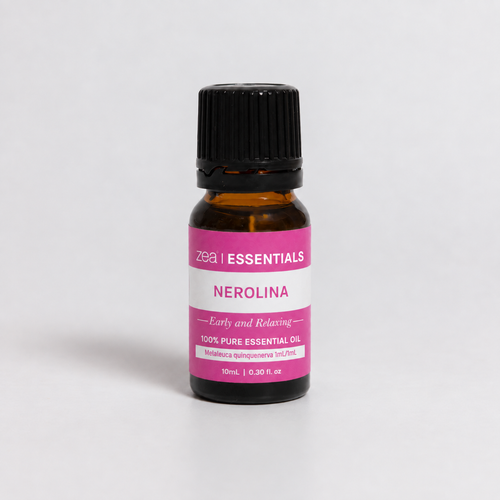
Rosalina is not the only Zea oil where linalool matters. Nerolina Essential Oil, distilled from a nerolidol/linalool chemotype of Melaleuca quinquenervia, carries a similar linalool proportion (around 33%) but is built around (E)-nerolidol at roughly 48%, with 1,8-cineole below 2%1. That nerolidol content is what pushes Nerolina toward a sweeter, more woody-floral character than Rosalina's brighter, more camphoraceous profile, even though both smell noticeably softer than Tea Tree.
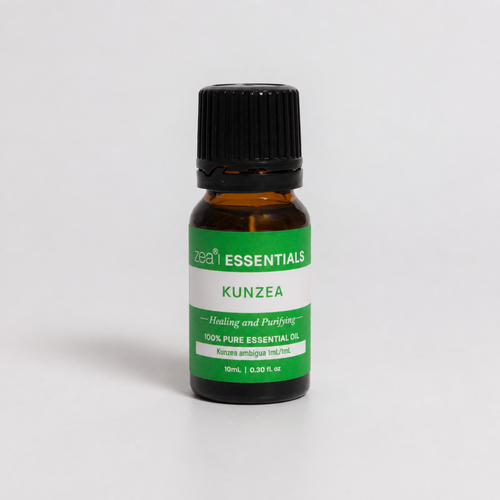
Kunzea Tasmania Essential Oil sits in a different genus again (Kunzea ambigua, not Melaleuca) and leans on alpha-pinene, 1,8-cineole and globulol rather than linalool, giving it a fresher, more herbaceous note. If you are building an aromatherapy routine across Zea's Australian native essential oils collection, Rosalina and Nerolina pair naturally as the softer, floral-leaning half of the range, while Kunzea and Tea Tree sit at the sharper, more medicinal end. Our companion piece on Kanuka vs Kunzea vs Manuka Oil goes deeper on how the wider Myrtaceae family compares if you want the fuller picture beyond just Melaleuca species, and What Is Kunzea Oil? covers Kunzea's own composition against Tea Tree in more detail.
Regional variation: Rosalina is not one fixed chemotype
One nuance worth knowing before buying by percentage alone: Melaleuca ericifolia oil composition is not fixed across its whole native range. Chemical surveys of the species have found that as you move south from Newcastle toward Tasmania, the proportion of 1,8-cineole in the oil tends to increase while linalool tends to decrease, and the variation is continuous rather than splitting cleanly into a "cineole type" and a "linalool type." That means two genuine, correctly labelled Rosalina oils sourced from different parts of the species' range can sit at different points on the linalool-to-cineole spectrum and both be accurate representations of the plant. It is one more reason to treat "Rosalina" as a real species with real regional variation, not a single fixed formula.

Aroma and blending
Rosalina's softer, rounder profile makes it a forgiving blending partner. It layers well with floral and citrus notes without fighting for attention the way a sharper terpinen-4-ol-dominant oil can, and it works as a gentler bridge note between a bright citrus top note and a woody or herbaceous base. Because the linalool content also overlaps with lavender's own aromatic profile, Rosalina is commonly reached for by people who like the idea of a lavender-adjacent evening blend but want something from the native Australian range instead.

Practical use: dilution, patch testing and diffusion
Rosalina is a cosmetic essential oil, not a listed medicine, and it should be used the same way any concentrated essential oil is used.
- Dilution: for topical use, dilute in a carrier oil before applying to skin. A common starting ratio for adult body use is around 1-2% essential oil in carrier oil (roughly 6-12 drops per 30ml), and lower again for facial use.
- Patch test: apply a small diluted amount to the inner forearm and wait 24 hours before wider use, every time you try a new oil or a new blend.
- Diffusion: Rosalina works well in an ultrasonic diffuser, typically 3-5 drops per standard diffuser reservoir, run in a well-ventilated room.
- Storage: keep the bottle capped, away from direct sunlight and heat, to protect the linalool content, which can oxidise over time and become more likely to irritate skin as it ages.
- When to check with a health professional: if you are pregnant, breastfeeding, have a diagnosed skin condition, or are using the oil around children, check with your GP or pharmacist before use. This is standard essential oil practice and applies regardless of how mild an oil's aroma is.
Frequently asked questions
What is Rosalina oil?
Rosalina is the essential oil steam distilled from Melaleuca ericifolia (Swamp Paperbark), a tree native to coastal New South Wales, Victoria and Tasmania. It is a cosmetic essential oil most commonly used in diffuser blends and diluted topical applications.
Is Rosalina the same as Tea Tree?
No. Rosalina comes from a different species, Melaleuca ericifolia, compared with Tea Tree's Melaleuca alternifolia. Their chemistry is also different: Rosalina is linalool-dominant (commonly 35-55%), while Tea Tree is required to sit at 30-48% terpinen-4-ol under the ISO 4730 standard1.
Why is Rosalina considered gentle?
Because of its constituent chemistry. Rosalina's aroma is carried mainly by linalool, a compound with an extremely low odour detection threshold that panelists most often describe as citrus-like, flowery and sweet, rather than by terpinen-4-ol, the sharper, more medicinal compound that dominates Tea Tree oil3. "Gentle" describes this aroma and feel, not a specific safety claim.
How do you dilute Rosalina oil?
For topical use, dilute Rosalina in a carrier oil, typically around 1-2% for adult body use (roughly 6-12 drops per 30ml of carrier oil), and use a lower dilution for facial applications. Always patch test a diluted blend before wider use.
Can you diffuse Rosalina at night?
Yes, Rosalina is commonly used in evening diffuser blends, typically 3-5 drops in a standard ultrasonic diffuser, in a well-ventilated room. As with any essential oil, check with a health professional before diffusing around infants, during pregnancy, or if anyone in the room has a respiratory condition.
References
Sources open in a new tab so you don't lose your place.
- 1. Farag, M.A. & Ahmed, S. HPTLC Analysis and Chemical Composition of Selected Melaleuca Essential Oils. Molecules 28(9):3925, 2023 (also indexed as PMC10180325). View source
- 2. PlantNET, The NSW Plant Information Network System, Royal Botanic Gardens Sydney. Melaleuca ericifolia Sm. View source
- 3. Elsharif, S.A., Banerjee, A. & Buettner, A. Structure-odor relationships of linalool, linalyl acetate and their corresponding oxygenated derivatives. Frontiers in Chemistry 3:57, 2015. View source