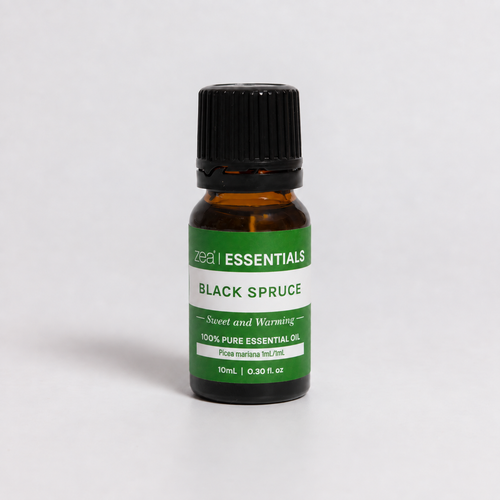
Black Spruce essential oil is steam distilled from the needles and twigs of Picea mariana, a conifer that grows across the boreal forests of Canada and the northern United States. It is not related to any Australian or New Zealand native plant. Its aroma is resinous and forest-like but rounder and sweeter than Pine, largely because commercial Black Spruce needle oil is dominated by bornyl acetate, an ester typically reported at 37-46.5% of the oil1. If you've smelled a real Christmas tree crossed with something faintly sweet, that's the profile.
Conifer oils get confused constantly. Black Spruce, Pine and Fir all come from different trees, in different genera, on opposite sides of the world from each other's native range, and each has a genuinely different constituent profile. Add in the fact that "spruce oil" is sometimes used loosely to cover several Picea species, and it's easy to see why shoppers land on the wrong bottle. This guide sets out what Black Spruce actually is, how it compares to Pine and Fir, and how to use and store it properly. You can browse Zea's own Black Spruce Essential Oil alongside the rest of the range while you read.
The three-way comparison, at a glance
Here's the direct comparison. The aroma differences people notice map onto real differences in dominant chemistry, not just marketing language145.
| Feature | Black Spruce | Pine | Fir |
|---|---|---|---|
| Botanical name | Picea mariana | Pinus sylvestris (Scots Pine) | Abies balsamea (Balsam Fir) |
| Native range | Boreal Canada, Alaska and the northern United States2 | Widespread across Europe and northern Asia | Eastern Canada and the north-eastern United States |
| Dominant constituents | Bornyl acetate (typically 37-46.5%), with alpha-pinene and camphene1 | Alpha-pinene, highly variable by chemotype (roughly 5-65% across studied samples); delta-3-carene often significant4 | Beta-pinene (around 22.5%) as the lead constituent, with bornyl acetate (around 18%), camphene and delta-3-carene5 |
| Aroma | Sweet, rounded, forest-like, slightly balsamic | Sharp, dry, resinous, more turpentine-like | Sweet, green, classic "Christmas tree" balsamic note |
| Typical use | Diffusion, grounding-scent blends, dilute topical blending | Diffusion, cleaning-scent blends, sharper forest notes | Diffusion, festive-season blends, sweeter forest notes |
| Regulatory status (as sold by Zea) | Cosmetic essential oil, not a listed medicine | Not currently stocked by Zea | Not currently stocked by Zea |
Botany and origin: a genuinely North American oil
Picea mariana, commonly called Black Spruce, bog spruce or swamp spruce, is a narrow, spire-shaped conifer that ranges "in a broad band from northern Massachusetts to northern Labrador on the Atlantic coast, west across Canada to the west coast of Alaska," with scattered southern outliers as far as New Jersey and southern Minnesota2. It favours cold, wet, organic soils, particularly peat bogs and other poorly drained sites, and grows in mean annual temperatures ranging "from 7°C in the southern areas to -11°C near tree line in central and western Canada"2. On productive sites it reaches 12 to 20 metres tall, though it shrinks to a stunted, wind-flagged form near the Arctic treeline. Black Spruce is also, commercially, the single most important pulpwood species in Canada2 - the same tree providing paper pulp across the northern hemisphere is the one behind this essential oil.
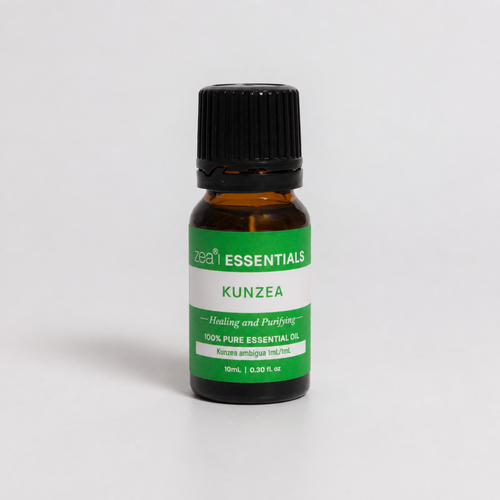
None of that overlaps with Zea's home range. The Kunzea Tasmania Essential Oil in Zea's core range comes from Kunzea ambigua, a shrub endemic to eastern Australia, grown from both sustainable plantations and wild-harvest stands in Tasmania - an entirely different genus, hemisphere and growing environment to Black Spruce. Stocking a genuinely distinct conifer oil like Black Spruce is why it sits in the Australian native essential oils collection alongside, rather than instead of, the native range. If you're curious how Kunzea's own chemistry compares to another commonly confused Myrtaceae oil, the Health Library article Kanuka vs Kunzea vs Manuka Oil works through the same kind of species mix-up on the Australasian side of the world.
Black Spruce is also sometimes confused with White Spruce (Picea glauca), a closely related North American conifer with an overlapping range and a broadly similar (though not identical) profile of pinenes and bornyl acetate. As with the Kanuka/Kunzea/Manuka mix-up, the common names travel further than the species do - "spruce oil" on its own is not a reliable indicator of which Picea species is actually in the bottle, which is part of why the botanical name is worth checking on any conifer oil label.

Aroma profile and blending partners
Black Spruce's bornyl-acetate-heavy chemistry gives it a rounder, sweeter, less sharp-edged conifer note than Pine, closer in character to Balsam Fir but slightly drier. That makes it a flexible base note for grounding or "forest floor" blends. It pairs well with:
- Citrus oils (Lemon, Bergamot) for a brighter, less heavy diffuser blend.
- Lavender for a calming evening scent profile.
- Eucalyptus or Peppermint for a sharper, more invigorating morning blend.
- Other Myrtaceae oils, such as Kunzea, for a layered native-and-boreal forest profile - two genuinely different plant families sharing a similar fresh, green register.
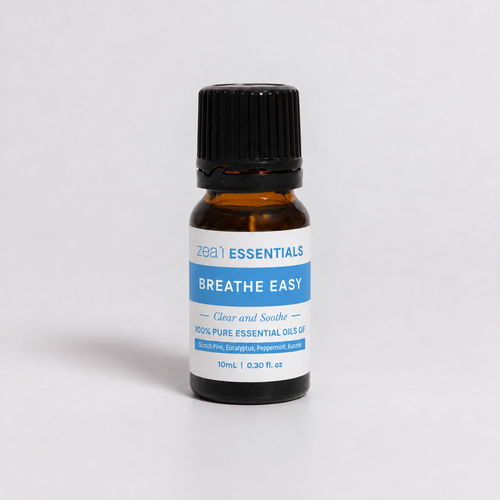
Zea's Breathe Easy Lifestyle Blend is a pre-formulated example of how conifer and Myrtaceae notes are commonly combined in aromatherapy blending, if you'd rather start from a ready-made blend than build one from single oils. If you want to understand what's actually driving that "fresh, green" note on the Kunzea side of the blend, the Health Library article What Is Kunzea Oil? covers its constituents (alpha-pinene, 1,8-cineole, globulol) in more depth, and pairs naturally with what's covered here on the boreal side.
A simple starting blend for a diffuser is 2 drops Black Spruce, 2 drops Lemon and 1 drop Lavender - sweet forest base, brightened top note, and a calming edge, without any one oil dominating.
Practical use: diffusion, dilution and patch testing
Black Spruce is a cosmetic essential oil. It carries no ARTG listing and should never be taken internally or applied undiluted to skin.
- Diffusion: 3-5 drops in a standard ultrasonic diffuser, run for 30-60 minutes at a time in a well-ventilated room.
- Topical dilution: a general cosmetic guideline is a 1-2% dilution in a carrier oil (roughly 6-12 drops per 30mL of carrier) for adult use on small areas.
- Patch test first: apply a diluted drop to the inner forearm and wait 24 hours before wider use, particularly with any monoterpene-rich oil.
- Not for young children, and check with your GP or pharmacist if pregnant, breastfeeding, or using on sensitive skin.

Storage: why monoterpene-rich oils need extra care
Black Spruce, like Pine and Fir, is rich in monoterpenes and monoterpene esters, and these compounds react with oxygen over time. This matters for more than shelf life. Oxidation of essential oil constituents can increase the risk of skin reactions, because the oxides and peroxides that form "are more reactive" than the parent compound, and this has been documented specifically for pinenes and related monoterpenes3. In practice, that means an old, air-exposed bottle of a conifer oil is more likely to irritate skin than a fresh one, even before any change in smell is obvious.
The fix is straightforward: keep Black Spruce (and any conifer oil) in a dark glass bottle, tightly sealed, stored in a cool place or refrigerator, and use it within the timeframe recommended on the bottle rather than keeping it indefinitely once opened3. A well-stored bottle, kept away from light, heat and repeated cap-opening, will hold its aroma and its lower irritancy profile far longer than one left on a sunny windowsill.
This is one of the reasons single-species labelling matters more with conifer oils than it might first appear. Because Black Spruce, Pine, Fir and White Spruce all share a resinous "forest" character to an untrained nose, an oxidised or blended bottle sold vaguely as "spruce" is harder to evaluate for freshness than one clearly labelled with its botanical name and expected constituent profile - another reason to check the species name on any conifer oil, not just Black Spruce, before adding it to a routine.
Frequently asked questions
What does Black Spruce smell like?
Sweet, resinous and forest-like, with a rounder edge than Pine because commercial Black Spruce needle oil is typically dominated by bornyl acetate rather than alpha-pinene1.
Is Black Spruce the same as Pine?
No. Black Spruce (Picea mariana) and Pine (Pinus sylvestris) are different genera native to different continents, with different dominant chemistry - Black Spruce leans on bornyl acetate, while Pine's profile is built around alpha-pinene and delta-3-carene and varies widely by chemotype4.
How do you dilute Black Spruce essential oil?
A common cosmetic guideline is around 1-2% in a carrier oil (about 6-12 drops per 30mL) for adult topical use, always with a patch test first.
Can you diffuse Black Spruce?
Yes. 3-5 drops in a standard diffuser, run in a well-ventilated room, is a typical starting point for a forest-scented diffuser blend.
How should you store conifer oils?
In a dark glass bottle, tightly sealed, kept cool or refrigerated. Monoterpene-rich oils like Black Spruce, Pine and Fir oxidise on air exposure, and the oxidation products are more likely to irritate skin than the fresh oil3.
References
Sources open in a new tab so you don't lose your place.
- 1. Boutin, C., et al. Chemical composition of essential oil and hydrosol from Picea mariana bark residue. BioResources. View source
- 2. USDA Forest Service. Picea mariana (Black Spruce), Silvics of North America. View source
- 3. Sarkic, A. & Stappen, I. Essential Oils as Natural Sources of Fragrance Compounds for Cosmetics and Cosmeceuticals. Cosmetics, PMC7865210. View source
- 4. Diaz, N., et al. Verification of Chromatographic Profile of Primary Essential Oil of Pinus sylvestris L. Combined with Chemometric Analysis. PMC7411901. View source
- 5. Study on Balsam Fir (Abies balsamea) needles and essential oil. PMC9338056. View source